
From TikTok to AI: Is Meta America’s Secret Weapon Against China?
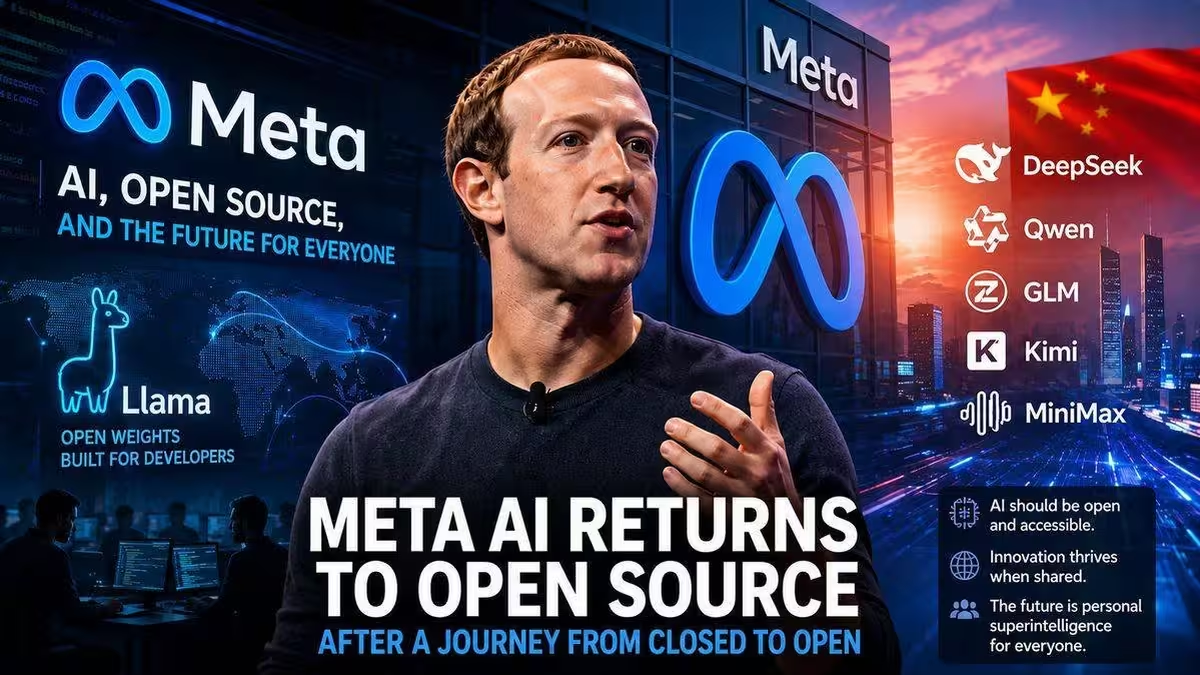
Unlike most American AI companies, which entered the current race behind tightly closed models, Meta once chose a different path. It released model weights, armed developers with Llama, and made openness part of its competitive identity. Then, apparently alarmed by the lead of OpenAI, Google, and Anthropic, it veered toward closed frontier systems. Now Meta is returning to open-weight AI as if to say: We were right the first time. But can it still catch China? And is releasing weights enough when the real contest is over who gets developers to build, deploy, and stay?
Over the past two days, developers have been absorbed by Meta’s announcement of Muse Glimmer, a 30-billion-parameter open-weight model released under the Apache 2.0 license and built for always-on local agents. Meta says it is optimized for persistent agent loops, reliable tool use, long-running tasks, and recovery when tool calls fail. More importantly, it is designed for local deployment, balancing capability against the memory and compute limits of personal hardware.
Yet the model itself may not be the most consequential part of Meta’s announcement. That distinction belongs to Mark Zuckerberg’s essay, “The Future Is for Everyone,” which makes clear that this is not simply another model launch. It is a struggle over the future architecture of artificial intelligence: who owns the keys, who controls access, and who gets to build on top of it.
Zuckerberg argues that concentrating advanced AI in the hands of a few companies is the wrong path. As AI becomes more powerful and more deeply embedded in society, he says, its capabilities should be broadly available—not transformed into a privilege controlled by a small corporate club.
The most revealing part of Meta’s strategic turn is the way Zuckerberg links openness to competition with China. He warns that slowing AI development or imposing sweeping restrictions on open-weight models could hand Beijing a decisive advantage. Openness, in Meta’s new doctrine, is no longer merely a technical philosophy. It is now a weapon in the geopolitical battle over who will shape the AI century.
Zuckerberg goes further than defending downloadable models. He imagines “personal superintelligence” reaching billions of people and small businesses, turning advanced AI from a centralized service rented from a few corporations into a personal instrument that users can control, customize, and deploy around their own needs.
The irony is impossible to miss. China appears to have extracted more strategic value from open-weight AI than most American companies, as labs behind DeepSeek, Qwen, and other Chinese model families pushed aggressively into the open ecosystem. Zuckerberg’s essay can therefore be read not merely as a philosophical defense of openness, but as Meta’s declaration that it is returning to a battlefield it once helped create—and then partially abandoned.
This is not the first time Meta has been forced to react to a technology wave coming out of China, or at least to rebuild its products around a Chinese model of success that Silicon Valley could no longer ignore.
Years ago, TikTok was the clearest example. After the spectacular rise of the short-video platform owned by ByteDance, Meta raced to launch Reels on Instagram and later pushed it across Facebook. Short video became one of the company’s most important competitive fronts. This was not the addition of a minor feature; it was a sweeping reorientation of the user experience around a format TikTok had already proved could dominate attention. Reels eventually became a colossal part of Meta’s empire, generating hundreds of billions of daily plays across Facebook and Instagram.
Now history appears to be repeating itself on a far more consequential battlefield. Just as Meta deployed Reels against TikTok, it now faces Chinese open-weight models such as DeepSeek, Qwen, GLM, Kimi, and MiniMax. Meta must reassess its position in a world where open models are no longer a technical side project, but one of the central arenas in the contest for AI dominance.
This time, the battle is not over how many minutes users spend scrolling through a social app. It is about something much deeper: Who will build the foundation on which everyone else builds?
Meta’s Journey From Open to Closed—and Back Again
This story is not simply about a new Meta model. It is about a startling shift in the company’s strategy. While OpenAI, Google, and Anthropic bet heavily on closed systems, Meta possessed a different weapon: Llama. By making model weights available, it allowed researchers, developers, and companies to customize the technology and build their own products on top of it.
That opened a different route through the AI market. Meta did not have to defeat ChatGPT by owning the final user. It could instead make Llama the underlying layer on which thousands of other companies built their future.
Then something changed. Meta watched its rivals race ahead with increasingly capable closed models and decided to chase them onto their own field. It began investing in more advanced, more centralized, and more tightly controlled systems in an attempt to match OpenAI, Google, and Anthropic at the game they had defined.
The result was a brutal paradox: while Meta stepped away from the open-model arena, China rushed into the space it left behind.
DeepSeek exploded onto the scene. Then the list of Chinese open and open-weight models expanded—from Qwen to GLM, Kimi, and MiniMax. It became impossible to dismiss these systems as merely cheap substitutes for American technology.
They became real competitors. More importantly, they did not remain demos or chatbots for curious users. They spread into companies, data centers, developer platforms, and production systems across the world. That makes this battle larger than benchmark scores or technical leaderboards. It is a contest to become the operating foundation for the next generation of AI applications.
Meta has now decided to come back. But its return cannot be separated from the rise of China. Zuckerberg himself frames the issue in geopolitical terms, arguing that American restrictions on open-weight AI could surrender part of the race to Chinese labs. He presents open models as cheaper, more customizable, and less vulnerable to control by a small group of corporate gatekeepers.
Zuckerberg’s essay can therefore be read in two ways. On one level, it is a statement about AI philosophy and a warning against allowing transformative technology to become the property of a few institutions. On another, it is Meta’s formal notice that it is re-entering a market it voluntarily left exposed.
The company that once insisted openness was the right path, then drifted away when closed models appeared more commercially powerful, has returned to tell the world that openness is the right path once again.
The World Meta Left Behind No Longer Exists
This time, Meta has an additional reason to move fast: China.
Meta’s early advantage is no longer exclusive. Llama helped establish the idea that a powerful model did not have to remain trapped behind one company’s interface. Chinese companies then seized that logic, industrialized it, and pushed it further.
That is Meta’s real problem. It is not returning to the open world it left. That world has been transformed. When Meta stood near the front of the movement, there were not this many powerful Chinese models competing for developers, deployments, and loyalty.
Today, Llama must confront DeepSeek, Qwen, GLM, Kimi, MiniMax, and a growing field of Chinese models that have become familiar names across the global open-weight ecosystem.
Still, Meta is not a minor player arriving helplessly at the starting line. It has the Llama legacy, extraordinary infrastructure, massive training capacity, deep engineering expertise, and a global developer community. It can also produce powerful models that run locally—something closed cloud services cannot offer in the same way.
There is another potential weapon: long context.
If Meta can release an open-weight system that combines frontier-level performance with an enormous context window, it could deliver immediate value to developers and enterprises working with large codebases, extensive document collections, complex projects, and long-running data workflows.
Open Weights Do Not Mean Free Access
Chinese companies have often been aggressive in offering developers generous API quotas and broad access through consumer chat services. Meta, by contrast, still needs to expand the practical infrastructure around its models. Publishing downloadable weights does not automatically create a free, affordable, or frictionless ecosystem.
Meta therefore has more work to do. The contest is not only about releasing model weights. It is also about opening practical gateways for developers, as Google and several Chinese companies have done. Meta previewed a Llama API, but winning the ecosystem will require sustained, accessible infrastructure—not a symbolic release followed by strategic hesitation.
An open model does not win merely because its weights can be downloaded. Its real power emerges when developers build applications on it, companies deploy it in data centers, researchers create new versions, and platforms embed it across their services.
The past few years have shown that a model’s power is not measured only by what it can do inside the laboratory that trained it. It is also measured by how many developers use it, how many companies build on it, and how large an ecosystem forms around it.
The smartest American company in the open-AI ecosystem may be Nvidia. But as a chipmaker, Nvidia cannot openly position itself as a direct rival to the customers spending billions of dollars on its processors.
It does not need to own the winning model to profit from the winner. Every expansion in models, agents, and applications increases demand for the compute infrastructure on which the entire ecosystem depends.
Can Meta Return to the Front?
Meta’s return to open-weight AI is not merely a technical move. It is a belated admission that the company may have possessed, from the beginning, the very card it is now desperately trying to recover.
The last several years have proved that model power is not defined solely by performance inside a corporate lab. It is defined by adoption, deployment, developer loyalty, and the size of the ecosystem built around it. On precisely those fronts, Chinese models have achieved gains that Silicon Valley can no longer afford to dismiss.
Meta is not starting from zero. Llama remains one of the heaviest names in open-weight AI. The company has the money, infrastructure, expertise, distribution, and developer base to claw back much of the ground China has taken.
But the time Meta wasted did not vanish. Its rivals invested every minute of it.
That makes Meta’s comeback harder than its original rise. The company must prove not only that it can release a powerful model, but that it has returned to stay. Developers need to believe Meta will not slam the door shut again the moment closed models appear more profitable.
If Meta can make that commitment, Llama’s return could become one of the biggest realignments in the AI market. Meta could once again stand as a foundational force alongside DeepSeek, GLM, Kimi, Qwen, and MiniMax.
But if Meta steps back into openness with one foot while keeping the other planted in the search for a more lucrative closed model, it could end up in the worst position imaginable: unable to defeat OpenAI and Google in the closed world, yet stripped of the leadership it once possessed in the open one.
Between those two outcomes lies one of the most dramatic questions in the AI race: Can Meta reclaim the future that might once have belonged to it—or did China take that future while Silicon Valley was looking the other way?