
Zhipu AI Unveils GLM-5.3-Flash: High Power, Much Lower Operating Costs
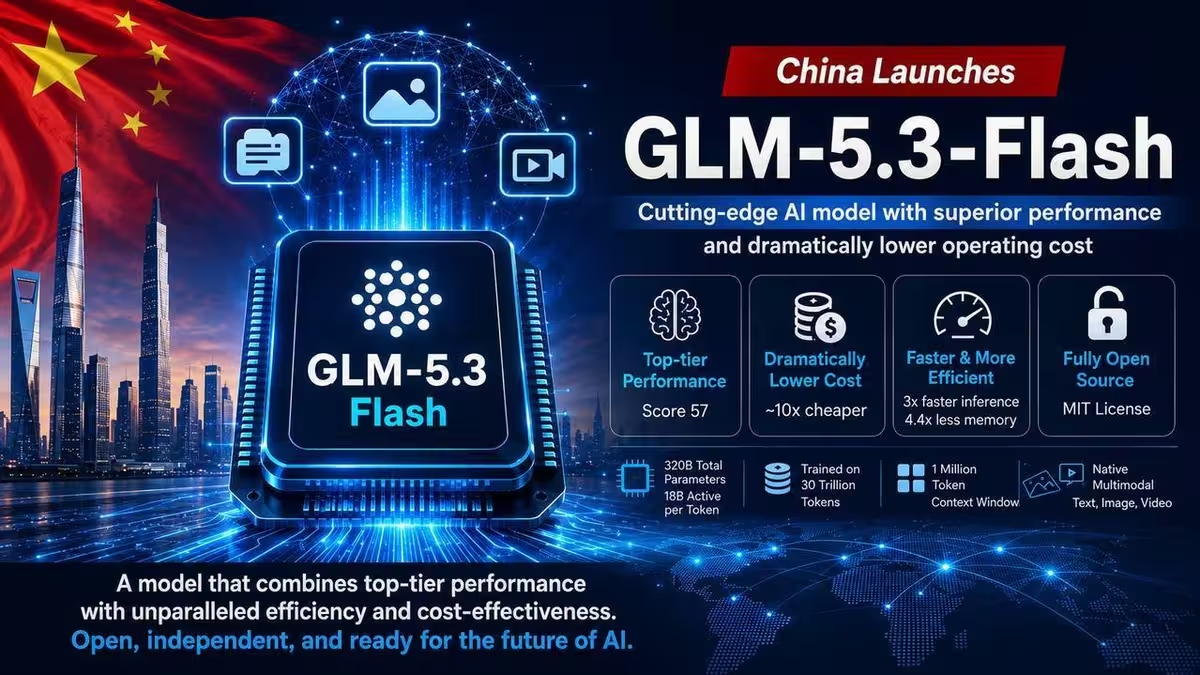
Zhipu AI's latest release sets a new benchmark in the AI race, delivering a multimodal model that combines top-tier performance with outstanding economic efficiency.
Once again, China steps into the spotlight with a new model in one of technology's hottest arenas. But this time, it is not just another Chinese version trying to catch up with Western giants. Instead, it represents a qualitative leap that merges advanced model capabilities with radically lower operating costs.
According to information reviewed by "Nashwan News,"Zhipu AI (智谱AI) launched the GLM-5.3-Flashmodel on Wednesday, August 26, 2026. This is the latest addition to the GLM-5 family and the first in the series designed from the ground up as anative multimodalmodel—meaning it inherently processes text, images, and video together as part of its core architecture, rather than being a text-only model with visual capabilities added later.
"Flash" Is Not a Shortcut, but an Operating Philosophy
The model boasts a total of 320 billion parameters, but the surprise is that it only activates 18 billion parameters when processing each token—meaning over 94% of its massive size remains dormant at every step. This is the secret behind the "Flash" designation: it is not a smaller, weaker model, but a giant intelligently managed to deliver massive savings in energy and computation without sacrificing quality.
Trained on 30 trillion multimodal tokens and equipped with a 1-million-token context window, it can digest massive software projects and lengthy documents in a single session. The company says its novel hybrid architecture reduces attention computations by roughly 3 times and cuts KV cache memory usage by about 4.4 times compared to previous versions—boosting both speed and operational efficiency.
Performance That Rivals the Best – at a Much Lower Cost
On the global Artificial Analysis Intelligence Index, the model scored57, a figure that places it directly in the category of world-class advanced models, matching the level ofClaude Opus 4.8, one of Anthropic's most powerful systems.
Yet, even more striking than performance is therevolutionary cost structure. Zhipu AI has priced the model at a highly competitive rate, making itroughly ten times cheaperthan its larger, more expensive sibling (GLM-5.3 max). This move is pivotal because cutting operating expenses is the real key to scaling the deployment of AI agents, which consume vast numbers of tokens during their operations.
A Silent Test on Chinese Soil
Interestingly, the model did not emerge from nowhere; it had already been running before the announcement. Zhipu AI quietly released it under the codename "Ox-Alpha" on the OpenCode and OpenRouter platforms to test it in a real-world environment with actual users. The company confirms it became the most popular model on both platforms during the testing period, and that all usage traffic ran entirely onChinese-made AI chips, without relying on cutting-edge American semiconductors.
Here lies the bigger story beyond just a new model: China is not only proving it can build competitive AI, but also that it can test and operate them at scale using independent, local infrastructure.
Two Strategic Choices: Peak Performance vs. Mass Deployment
To fully grasp the model's position, it must be compared to its bigger brother, GLM-5.3 (max), which remains the strongest in the family in terms of raw intelligence. While the larger sibling leads in the intelligence index (60 vs. 57), has more parameters, and offers faster output,GLM-5.3-Flashemerges as the smarter economic and strategic choice. It is about ten times cheaper, faster in time-to-first-token, natively supports images, and—most importantly—isfully open-source under the permissive MIT license, allowing free commercial use and modification. In contrast, the larger model remains closed and proprietary.
With this, Zhipu AI offers two complementary options: a top-performance model for those needing maximum intelligence, and a cost-revolutionary, open model for those looking to deploy AI at scale without financial or licensing constraints.
What Comes Next?
The company had already proven its mettle with previous releases that competed with Anthropic's models in coding and cybersecurity. Today, it takes another step forward—not just chasing American models, but offering a distinct alternative built onhigher efficiency, open weights, and a far lower price point.
In this context, this release—alongside achievements by other Chinese firms like DeepSeek, Qwen, and Kimi—shows that Chinese competition is no longer just about finding a cheaper alternative. It has become a whole new battleground.
The tech race between Washington and Beijing has shifted from the question of"Who has the most powerful model?"to a more dangerous and strategic one:
"Who can make advanced AI cheaper, more widespread, and more independent from American restrictions?"